

The SARMs Loophole: What “Not Illegal” Actually Gets You (Hint: Nothing)
Here’s a mix-up I see constantly, and it costs people money and sometimes their health. Someone finds a SARM for sale online, credit card accepted, no prescription needed, and they assume that means it passed through some kind of checkpoint. It didn’t. Then they notice nobody ever wrote a law banning the stuff by name, so they figure it must be fine. That’s the wrong read, and it matters, because the legal status of what you’re buying determines who’s on the hook if the product is contaminated, mislabeled, or just wrong for you. Right now, on the SARM side, the answer is nobody.
This is your plain-language walkthrough of where SARMs and peptides actually sit with regulators in 2026. I’m not telling you what to buy or not buy. I’m giving you the checklist to run before you hand anyone your money.
First check: “unapproved” is not “illegal,” and that gap is where the whole gray market lives
Run this check first, because it clears up more confusion than anything else on this topic.
A SARM is an unapproved drug. The FDA has said so directly: products containing SARMs are unapproved drugs the agency has never reviewed for safety or effectiveness, and slapping “dietary supplement” or “research use only” on the label doesn’t change that they cannot be legally marketed in the U.S. as either a supplement or a drug [P1]. So selling them for someone to actually take is against the rules. That’s why the FDA keeps issuing warning letters to sellers, as recently as December 2025 [P5].
But here’s the twist people miss. SARMs are not scheduled controlled substances at the federal level. Congress has tried to close that gap. A bill called the SARMs Control Act showed up more than once, including a 2019 version that would have put SARMs under DEA authority, the same way anabolic steroids are handled [P3]. It never passed. So as of 2026 you’ve got a product that’s not approved, not legal to sell for human consumption, and yet also not formally scheduled like a narcotic. That gap between “banned” and “approved” is roomy enough for an entire industry to operate in it.
Red flag #1: the “research use only” sticker
Treat this label as a warning sign, not a disclaimer you can skim past.
When something says “for research use only” or “not for human consumption,” the seller is telling a regulator, in writing, that the product was never meant to go in a person. That’s not a technicality. It’s the legal fig leaf that lets the sale happen in the first place. And it has a very direct consequence for you: no clinician can legally prescribe it, no pharmacy stands behind what’s in the vial, and there’s no recourse if it turns out to be wrong.
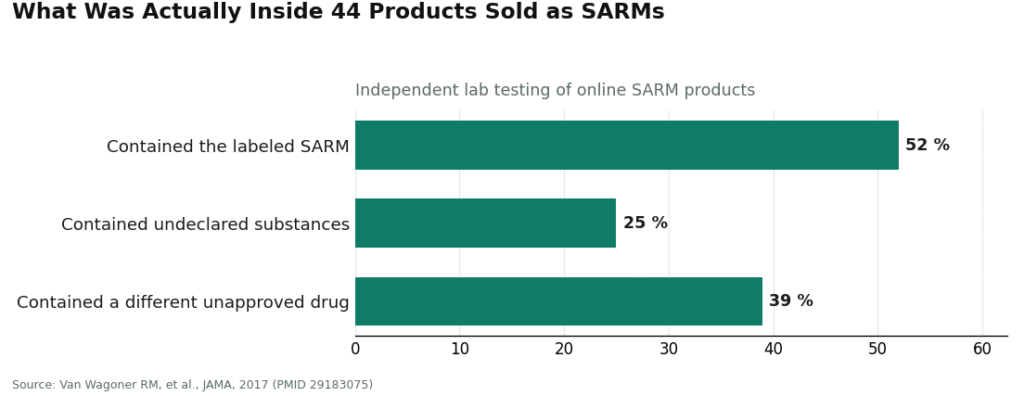
Here’s what “wrong” looks like in practice. Researchers bought 44 products sold online as SARMs and tested them in a lab. Only 52% actually contained the SARM printed on the label. Around 25% had undeclared substances mixed in, and about 39% contained an entirely different unapproved drug [P2]. Run those numbers again. The label you’re trusting is close to a coin flip.
Red flag #2: it can end your season even if you never touched one
If you compete in anything drug-tested, put this on your checklist whether or not you’ve ever considered a SARM.
SARMs are banned in sport at all times, in and out of competition, at every level, classified as anabolic agents under the WADA code [P4]. The trap is that contaminated supplements are common enough that people test positive without ever knowingly taking a SARM, because the product that got them there never listed one on the label. That’s the same testing data from above: undeclared ingredients showing up in supplements that were never marketed as SARMs [P2]. A career can end over a tub of something that looked clean on the label.
The peptide side has more categories, and that’s actually the reassuring part
Peptides don’t get a free pass here either, and I’m not going to tell you they do. But the legal map is genuinely different, and different in your favor. Check which bucket you’re actually looking at before you buy anything:
- FDA-approved peptide drugs. Full agency review. Real medications, legally prescribed.
- Compounded peptide medications. Not FDA-approved as finished products, that’s a real limitation and I won’t pretend otherwise, but a licensed pharmacy prepares these against a valid prescription under recognized standards. A clinician is involved. Someone is accountable.
- Research-status peptides. Sold exactly like SARMs, same “research only” dodge, same lack of oversight. Treat these with the same suspicion you’d give a SARM vial.
The takeaway isn’t that every peptide is safe. It’s that the peptide category has a legitimate, supervised lane where a licensed prescriber and a licensed pharmacy are both in the loop. SARMs have no such lane, because there’s nothing in that category approved to prescribe [P4]. That’s the whole comparison in one line: one category has someone legally responsible for your care built in. The other doesn’t.
Why is this stuff still everywhere if it’s not legal to sell? Check the enforcement math
Fair question, and the answer should worry you more than reassure you.
Enforcement here is whack-a-mole. The FDA sends warning letters, it did so again in December 2025 to a SARM seller [P5], but a warning letter doesn’t flip a switch and shut a site down that afternoon. A flagged seller can rebrand, relabel, and keep shipping while the paperwork grinds along. So the fact that these products are still around isn’t proof anyone signed off on them. It’s proof the rules are easier to break than to enforce, and that the burden of catching a bad batch lands on you, not the person who sold it to you.
Compare that to how an approved or compounded medication reaches you: licensed prescriber, licensed pharmacy, recognized standards, a paper trail with names attached. If something goes wrong, there’s someone you can actually point to. That’s not a minor administrative detail. It’s the difference between a system built to protect you and one built to protect a seller.
The pick, if you’re going to do anything in this space
Here’s my actual recommendation, and it’s not a product, it’s a filter: put a licensed professional between you and whatever you’re considering.
That doesn’t make a research chemical safe. A clinician can’t do that. But the supervised route restores everything the gray market strips out: a real look at your health history and other medications, an actual prescription, a licensed pharmacy that checks identity and purity, honest talk about how strong (or thin) the evidence is, and a person you can reach if something feels off.
On the peptide side, FormBlends is one example of that supervised model in action, a physician-supervised telehealth service where a clinician evaluates you and a prescription gets dispensed through licensed pharmacies. I’m naming it once as an illustration of what accountable looks like, not as a product to buy off this page. And notice what falls out of this automatically: a compliant provider structurally cannot sell you a SARM, because there’s no approved SARM to dispense. The legal status of the category decides what a responsible provider is even allowed to put in front of you.
Bottom line checklist
Before you buy anything in this space, ask:
- Is it FDA-approved, or is “unapproved” doing a lot of quiet work on the label? SARMs fail this check outright [P1].
- Is it scheduled, or just sitting in the gap where the SARMs Control Act failed to land it [P3]?
- Does “research use only” appear anywhere? Treat that as a legal shield for the seller, not a safety claim for you. Roughly half of tested SARM products didn’t even match their own label [P2].
- If you compete, is it banned regardless of intent? SARMs are, at every level [P4].
- Is there a licensed clinician and pharmacy in the chain, or just a warehouse and a warning letter waiting to happen [P5]?
Peptides can clear that last checkbox. SARMs, by law, cannot.
A few common questions
Are SARMs illegal to buy in the United States? Not in the way most people assume. SARMs are unapproved drugs that can’t be legally marketed or sold for human consumption, so the companies selling them that way are operating outside the rules. But SARMs aren’t scheduled controlled substances federally. They sit in a gap: not approved, not legal to sell for you to take, and not formally scheduled like a narcotic. That gap is exactly why an online gray market keeps running.
Does “for research use only” on the label mean the product is safe or tested? No, the opposite in practice. That line is a legal device letting the seller tell a regulator this was never meant for human use, which is the basis the whole sale rests on. It’s not a quality mark. Lab testing on 44 products sold online as SARMs found only 52% actually contained the labeled SARM, about 25% had undeclared substances, and roughly 39% held a different unapproved drug entirely.
Why is this stuff still sold everywhere if it can’t legally go to a human being? Because enforcement is slow and the rules are easier to break than to police. The FDA sends warning letters, including one to a SARM seller as recently as December 2025, but a letter doesn’t shut a storefront down instantly. A flagged seller can rebrand or relabel and keep shipping while enforcement catches up. Availability is a sign of weak enforcement, not a sign of approval.
Can a SARM tank a drug test even if I never knowingly took one? Yes. SARMs are prohibited in sport at all times, in and out of competition, for every athlete, as anabolic agents. Because supplement contamination is common, people test positive from products that never even listed a SARM on the label. The same testing that found half of SARM products mislabeled also turned up undeclared ingredients in supplements, so a career can end over a product someone genuinely believed was clean.
How is the legal status of peptides different from SARMs? Peptides split into several legal buckets, not one. Some are FDA-approved prescription drugs, some are compounded medications a licensed pharmacy prepares against a valid prescription, and some are sold gray-market “research only” exactly like SARMs. The difference that matters: the peptide category has a lawful, supervised path with a licensed prescriber and accountable pharmacy. The SARM category has no such path, because nothing in it is approved to prescribe.
If I’m going to use something in this space anyway, what actually lowers my risk? Put a licensed professional between you and the product. That doesn’t make a research chemical safe, nothing does, but the supervised route brings back what the gray market removes: an evaluation of your health and medications, a real prescription, a pharmacy that verifies identity and purity, honest information about how solid the evidence is, and someone reachable if something feels wrong. Worth noting: a compliant supervised provider structurally can’t sell you a SARM, since there’s no approved SARM to dispense.
Sources
- Products containing SARMs are unapproved drugs that have not been reviewed for safety and effectiveness; though marketed as dietary supplements or “sold for research use only,” they cannot be legally marketed in the U.S. as a dietary supplement or drug; risks include liver injury requiring hospitalization and increased risk of heart attack or stroke. U.S. Food and Drug Administration. https://www.fda.gov/drugs/fraudulent-products/certain-bodybuilding-products-put-consumers-risk-heart-attack-stroke-serious-liver-damage-and-more
- Of 44 products sold online as SARMs, only 52% contained the labeled SARM; 25% contained undeclared substances and 39% contained a different unapproved drug. Van Wagoner RM, et al. JAMA, 2017. https://pubmed.ncbi.nlm.nih.gov/29183075/
- SARMs Control Act of 2019, proposing to place SARMs under the Controlled Substances Act framework administered by the DEA; introduced in the Senate and not enacted into law. 116th Congress, S.2895.
- All SARMs are investigational and not FDA-approved; there are no FDA-approved SARMs available for prescription; SARMs are prohibited in sport at all times, in and out of competition, for all athletes, as anabolic agents. U.S. Anti-Doping Agency.
- FDA warning letter to a SARM seller, December 12, 2025, citing the unlawful marketing of SARM-containing products as unapproved new drugs. U.S. Food and Drug Administration, Warning Letters.
This piece does not endorse SARMs or recommend their use. SARMs are unapproved drugs that cannot be legally marketed for human use in the U.S., carry documented liver, cardiovascular, and hormonal risks, and cannot be legally prescribed. Among peptides, some are prescription or compounded medications; compounded medications are not FDA-approved finished drug products. Talk to a licensed clinician before making any decision.
So what actually are peptides and SARMs, and are they the same thing?
Not remotely. Peptides are short chains of amino acids, some occurring naturally in your body, and they signal processes like tissue repair or hormone release. SARMs are synthetic small molecules built to bind androgen receptors selectively. Fitness marketing lumps them together constantly, but the chemistry, the legal status, and the risk profile are all genuinely different animals.
Which one is actually the safer bet?
Some research peptides have longer clinical safety records than SARMs do, but don’t hear “safer” as “safe.” SARMs can suppress your natural testosterone and have shown liver stress markers in some users. Peptides carry their own risks depending on the specific compound. Honest answer: human safety data on most of this stuff is thin across the board, and anyone selling you certainty is overselling what the science actually supports.
Why does the price swing so wildly?
Street prices run anywhere from roughly twenty dollars to several hundred per cycle depending on the compound and the source. That spread reflects manufacturing quality, whether purity testing happened at all, and whether the seller answers to anyone. Cheap products tend to skip third-party lab verification, and given how common contamination and mislabeling are in independent testing, that’s exactly the corner you don’t want cut. Price alone tells you almost nothing about what’s actually in the vial. Don’t use it as your safety signal.
Is there an actual accountable route to buy any of this, instead of a random vendor?
A physician-supervised compounding pharmacy is your most accountable option. Some clinics run through compounding pharmacies for this purpose, and FormBlends operates in that supervised lane for certain peptides. Outside that route, you’re mostly dealing with research-chemical vendors who answer to no regulator and carry no liability if the product hurts you. That accountability gap is the whole point of this piece, and it’s worth taking seriously before your card gets charged.
Written by Bram Eriksen, medical writer. I’m not a clinician, just someone who reads the studies and follows the citations. Last reviewed May 2026.
Informational content only. Speak with a qualified healthcare provider about your own situation.